
The Italians are accredited with many obsessions, Venetians in particular. I, for once, am not referring to pizza, pasta, coffee or sex, but rather a smaller, four-legged friend, whose existence is prevalent in the floating city. Dogs.
The animal traditionally associated with the streets of Venice is the cat. The alley cats who roam rooftops and walled gardens have been the focus of many books and articles observing Venice; however, at first glance I found very little relating to our K9 friends. Admittedly, I am biased towards dogs, yet I cannot deny that this recent transition sparked an interest as to how this naturally less graceful species has adapted to life in this peculiar city.
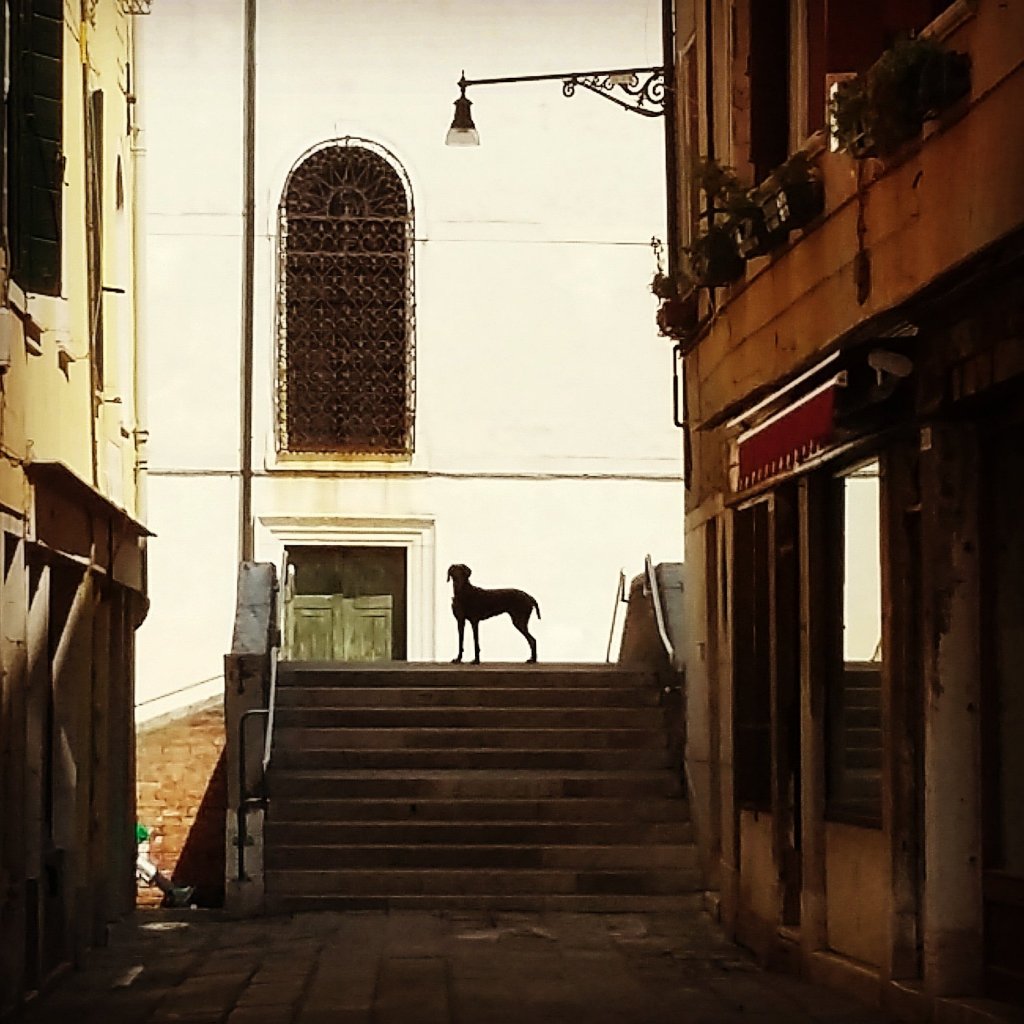
I fear that no one truly admires or appreciates the effort that is required of man’s best friend on a daily basis. Have you ever considered the struggles of a Dachshund, Chihuahua or a Pomeranian as they approach the mountain that is a Venetian footbridge? Or the discrimination that a Hungarian Vizsla, Doberman or Retriever faces when simply visiting a café? Granted, dogs may not be the first thing that come to mind when thinking of Venice, but multiple questions regarding their life in the city spring to mind: Are they on leads? In bags? Can they travel by boat? Well, I can now confirm that the answer to all these questions is yes. Dogs are everywhere! They accompany their owners on their commutes, either via foot, vaporetto, or, in true Peggy Guggenheim style, on a private gondola. I feel compelled to applaud the immaculate conduct of these four-legged citizens. Undoubtedly, my favourite Venetian discovery thus far is that dogs are not solely sociable companions, but are permitted to help with delivery services across the island. My daily commute allows me to see Leo, the golden retriever, who accompanies his owner Jacopo on their barge as they deliver boxes in Dorsoduro.
With the feeling that I have now adequately explained my respect for Venetian dogs, I will now turn to the surprisingly distinguished history of Venetian cats, for those of you who (I believe, incorrectly) favour cats to dogs…
Venetians have lived side by side with cats for centuries, as they hold an almost prestigious title in Venetian society. Introduced from the Middle East as a method to control the local pests, they roamed freely and can be accredited for their contribution to saving the city from the Black Death of 1348. Famous Venetian cats include: the cat belonging to Doge Francesco Morosini, the naval commander, who heroically ventured to war with his owner, and Nini; the white feline who inhabited the Caffe dei Frari until his death, only to be honoured with a wake in 1894.

In 2016, Marco Secchi took feline studies a step further and drew a comparison between Venetian cats and the Venetians themselves. He commented that “the cats disappeared like the Venetians are disappearing.” As a member of the group Awakening, an environmental, cat-loving journalistic group, Secchi has highlighted the effect of tourism on Venice, and how it has negatively affected the numbers of Venetian locals, both human and feline.
Whilst the population of Venice has dropped from 120,000 to around half of that figure in the last 30 years, the number of tourists has catapulted to more than 20 million every year. This shift in human demographic is not unexpected, yet, once again, its impact on the livelihood of cats is overlooked. Whilst it is clear that they possess the ability to outlive the devastating floods, it would seem that cats are struggling to survive the overflow of tourists, as their hiding spots in the piazzas and on the rooftops are now overrun with selfie sticks and spritz-seeking visitors.
© S R D HILL
 Not Sophia Loren